Subject-verb agreement is a fundamental aspect of English grammar that ensures the subject and verb in a sentence agree in number. This means that singular subjects must have singular verbs, and plural subjects must have plural verbs. Understanding and applying subject-verb agreement rules correctly is essential for clear and effective communication in writing.
Subject-verb agreement can be tricky, especially when dealing with more complex sentence structures or irregular verbs. However, having a solid grasp of the basic rules can help you navigate these challenges with confidence. Below are some printable subject-verb agreement rules to help you improve your grammar skills.
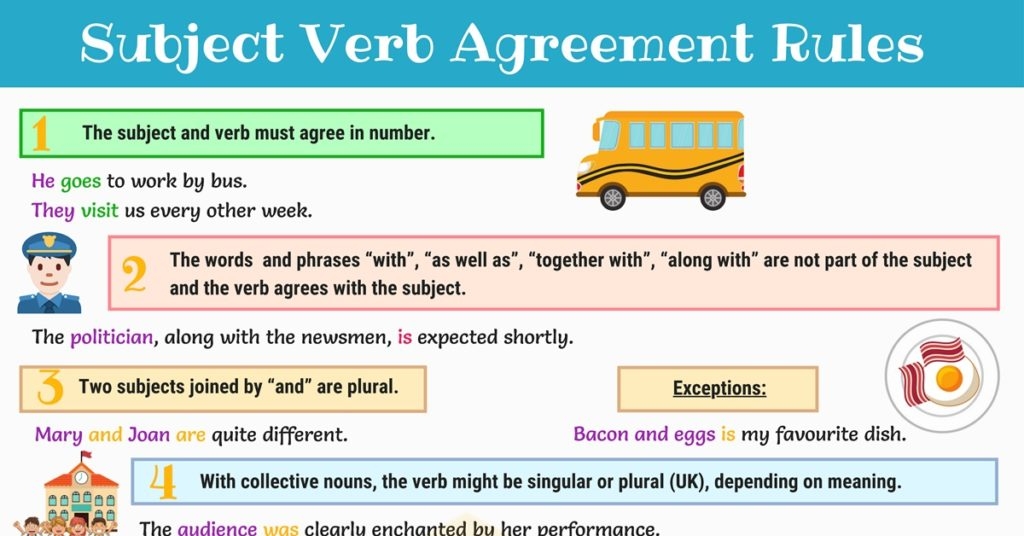 Printable Subject Verb Agreement Rules
Printable Subject Verb Agreement Rules
1. Singular subjects take singular verbs, while plural subjects take plural verbs. For example: “The dog barks” (singular) and “The dogs bark” (plural).
2. When a compound subject is joined by “and,” it usually takes a plural verb. For example: “Tom and Jerry are friends.”
3. When a compound subject is joined by “or” or “nor,” the verb agrees with the subject closest to it. For example: “Neither the cat nor the dog is happy.”
4. Collective nouns, such as team, family, or audience, can be singular or plural depending on context. For example: “The team is winning” (singular) and “The team are arguing” (plural).
5. Indefinite pronouns, such as everyone, nobody, or each, are singular and take singular verbs. For example: “Nobody knows the answer.”
By following these subject-verb agreement rules and practicing regularly, you can enhance your writing skills and improve the clarity and coherence of your sentences. Remember to pay attention to the subject-verb agreement in your writing to avoid common grammar mistakes and convey your ideas effectively.
In conclusion, mastering subject-verb agreement rules is essential for proficient writing in English. These printable rules serve as a handy reference guide to help you ensure that your subjects and verbs agree in number, leading to clearer and more precise communication. Practice applying these rules in your writing to enhance your grammar skills and become a more effective communicator.